Alastair Henshaw is part of the leadership group, in charge of Community Outreach in Wellington. He works with residents and volunteers to help build the trap network. He spoke with Predator Free Bay of Plenty leaders about the work, results, mistakes and successes of Predator Free Wellington, building on the success of pest eradication and control on the Miramar Peninsula. Whakamārama Forest Project’s Noelene Taylor filed this report.
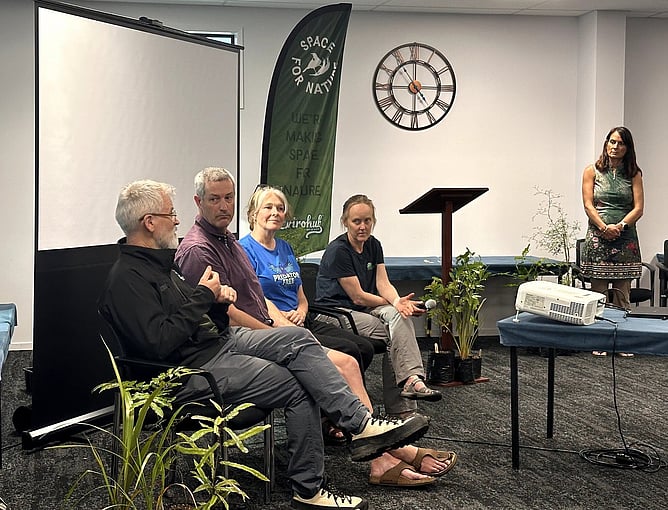
From left, Alastair Henshaw of Predator Free Wellington; Michael Barton, Tauranga City Council; Rose Riley, Predator Free BOP & Space for Nature; Emma Cronin, Bay Conservation Alliance & KEEP - Kōkako Ecosystem Expansion Programme; and, standing, MC, Councillor Kat Macmillan Toi Moana Bay of Plenty Regional Council, taking part in a panel discussion at a public meeting on Oct. 10. Photo from Predator Free BOP.
We may not have a Zealandia in the Bay of Plenty, and Alastair Henshaw is not recommending cities invest in expensive predator fences, but he sees huge community gains can come from supporting urban bird populations. More birds leads to more community gains through connection, engagement and positive support for nature.
Alastair is positive about goodwill in neighbourhoods towards backyard trapping, even from cat owners who are starting to view their responsibilities differently. He is also positive about combining small groups into bigger regional organisations that can work toward the goal of Predator Free 2050. He believes that even if we only reach 50% predator free by 2050, we can’t get there without helping regions to “just get going”. He also admits that we won’t achieve the 2050 goal without new innovation, which could include AI technology, rat specific toxin, cameras.
His underlying message was similar to that of science writer, Helen Pilcher, who has used New Zealand’s campaign to save the kākāpō as an example of how hope works - and it’s not magical thinking or vague optimism.
Helen Pilcher wrote in The Guardian; “Real hope has its sleeves rolled up and is prepared to get messy. It leaves room for uncertainty and failure but refuses to believe that there’s nothing left to do. That’s why the opposite of hope isn’t despair. It’s inaction. …
In 1995, there were just 51 kākāpō. Today, there are 324, a remarkable turnaround for such a slow-breeding bird. Conservation plans are still evolving, and the species isn’t out of the woods yet. But at least it has a fighting chance.
That’s the kind of hope we need: pragmatic, resilient and open to revision. We need our governments to be honest about the scale of the challenge we face. Because when they withhold information, they don’t just rob us of knowledge. They also rob us of hope.”